
Climate consciousness is pushing people to limit international travel at a point when we need more global citizens than ever before.
By Simon Doble
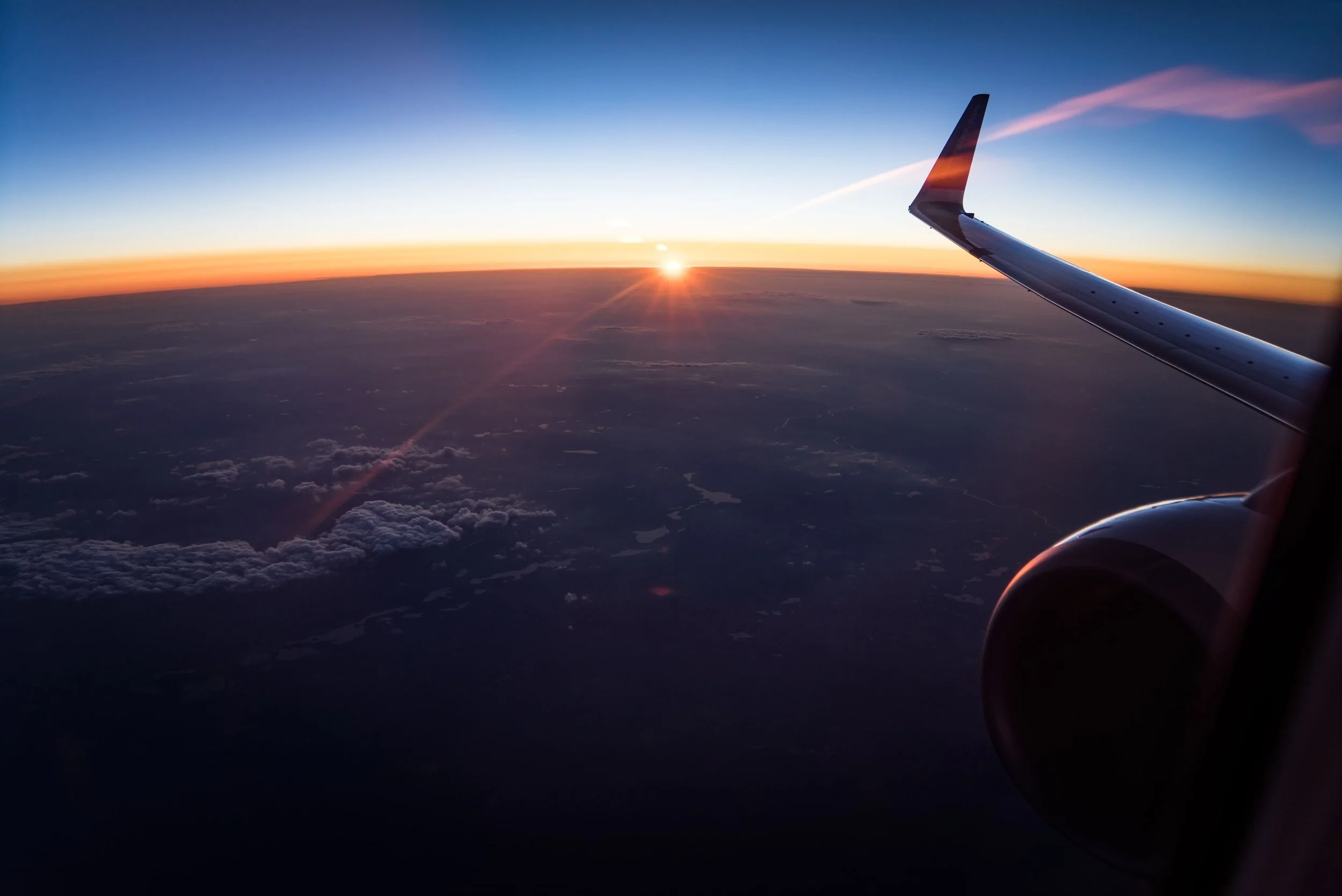
When I say travelling has saved my life, it’s not an overstatement. I was 16 years old when I decided to travel across Europe. Frankly, I was flunking school, it didn’t seem interesting. Definitely not compared to what was happening in Germany at that time. As Britain was catching glimpses of the historic events of 1989 on the telly, I was phoning home, “Mom, guess what? I’m in Berlin. The wall is down. You cannot imagine the scene.”
Just as you see families hugging and crying at the airport after a week or a month away, I saw German families who hadn’t seen each other for several decades. It was the airport kisses times a thousand. The atmosphere was electric, exhilarating… and it became a key turning point in my life, setting me up for my first big success back in the UK.
A few years later, when I got myself into some serious trouble (again), waking up in the hospital bed after and the whole ER team welcoming me back into the world, I knew I had to leave England and do some serious soul searching. For a few years after that I was travelling the world, meeting people from all over, seeing how communities lived, how societies that were the polar opposite of where I grew up could thrive in their own ways.
That was also when I first encountered energy poverty, albeit without fully comprehending what it was and all of its devastating consequences. Had I stayed in England, not only would I not have ended up where I did, my beautiful children, my life’s purpose, nothing would be here. I’m quite certain that I wouldn’t be here had I stayed in England.
What You Might Encounter on the Road
In centuries past, international travel was reserved for the select few. By the 1800s, young British nobility would embark on grand tours to Italy, Greece or the Orient, enriching their lives and with that, the culture of that time. Arts and sciences flourished. But this was still fewer than one percent of the population. The majority wouldn’t see much more than the capital city.
Tides began to shift only by the mid-1900s with the advent of air travel and the international tourism as we know it today. These were the conditions that allowed a 16-year-old to go see history. And by the 2020s, an ever-larger proportion of the global population could choose to expand their horizons and -- in place of yielding to fear from the unknown -- see the world for themselves.
Those that chose to take the leap and explore the world today have a tapestry of characters, cultures and ideas to discover. Yet they will also encounter the bewildering scale of environmental degradation in the process. Extreme weather events are becoming painfully common, the signs of pollution, deforestation and drought sending all but the most hardened travellers into a spiral of despair when relaxation should be on their minds.
What's more, the global travel and tourism industry accounts for roughly 7–9 percent of global greenhouse gas emissions. Cleaning it up will be a massive challenge, especially in aviation, which produces 12 percent of all CO2 from transportation, no scalable green alternative exists yet for medium- and long-haul flights.
As a result, many conscious would-be travellers see a plane and say: "No, thank you." I think this would be a terrible mistake. We will need as many global citizens as we can have to build a better future, to create smarter models and connect ideas no one thought of before. People who understand how the world works and see what's happening beyond their immediate surroundings, who act in the face of fear and adversity, who build bridges in an increasingly divided world. Those will become tomorrow's innovators.
What Shakes You to Your Core
It was in 2011 when I first learned about energy poverty from an article in Time magazine and it shook me. I was appalled by myself, for not realizing sooner. I'd seen energy poverty before, when I was travelling, in Asia, in Africa, all over, I just didn't fully comprehend the scale of the issue and what it meant for the families, for children growing up in these conditions.
But in order to act, I needed to talk to a single mother in Somalia to understand her point of view, speak to the people in the UN and learn about the latest in solar technology in Asia. I needed to be able to travel.
Countless bold little girls and bright young boys out there need to see the world for themselves to build the solutions we need. Giving them the opportunity to travel is essential. And that means we should avoid environmental transformation making travel accessible only to a select few -- the grand-touring nobility, the one percent -- because that would severely limit our ability to innovate and solve the monumental challenge that is climate change.
This can be achieved thanks to targeted and purposeful innovation. With advanced trend anticipation and clever scheduling, we can improve efficiency and link with other modes of transport like rail. And the adoption of sustainable aviation fuel (SAF) and carbon offsetting mechanisms like CORSIA or EU ETS further helps bridge the gap before we can have an entirely emission-free transportation sector.
That is not to say that the current pace will be sufficient. There's a massive, untapped potential in ways in which carbon offsetting can be used not only to account for excess emissions, but to improve the lives and prospects of millions of children, lifting them from poverty and allowing them to become global citizens.
This is not a distant possibility, it's happening today. There are children going to school in Guyana using a boat that was funded by an airline through CORSIA, and much more can be done with clean cooking.
Accounting for CO2 emissions and environmental protection can and should come hand in hand with improvements in health, safety, connection and education prospects in places that are bearing the brunt of our environmental impact. The children growing up in poverty next to a toxic e-waste site today will be best positioned to do something about it tomorrow.
"Do the best you can until you know better. Then when you know better, do better.”
– Maya Angelou